Astrid and Helge Landmark’s Marriage
The CallerAstrid and Helge Landmark’s Marriage is a partnership forced into painful proximity with death by Helge’s progressive paralysis. At home, care becomes a daily negotiation between his fear and dependence and Astrid’s effort to keep functioning. Their love is not presented as a simple comfort: she remains responsible for his practical needs while privately struggling with the misery and anger that his decline awakens in her. The arrival of a hearse at their gate, sent as a prank, makes the death they have scarcely managed to discuss seem to enter their home in physical form.
A Marriage Reorganized by Illness
Astrid has recently turned fifty-three; Helge is fifty-nine, though, sitting in his wheelchair before the television, he seems much older. The progression of his paralysis is relentless. Astrid understands that he will lose the ability to swallow, speak, and breathe, and the couple knows what to expect as his illness advances. That knowledge does not make the future easier to face. Instead, it narrows the space in which they can speak to one another: ordinary phrases such as “until spring,” “next Christmas,” or “another time” have become impossible because the future they imply may not exist for Helge.
The illness changes the balance of their domestic life. Helge, once remembered as big, strong, playful, and in charge, now relies on Astrid and has little strength to resist his fear. He cannot follow the programme on television, and he is uncomfortable with visitors seeing him in his present condition. His world has contracted around pain, sorrow, and dread. Astrid, meanwhile, is left to manage the household and imagine its future without him: whether to keep the cabin at Blefjell, which Helge called El Dorado because it was such a money pit; whether she can maintain the house; and who will mow the lawn, clear snow, stain the house, or prune the fruit trees.
Care, Silence, and Private Despair
Astrid’s care takes the form of repeated, ordinary work. She irons Helge’s shirts, handles the laundry, and plans to knead bread dough, wash the front-door window, and sweep the kitchen. The ironing is unnecessary—the shirts have come from the dryer soft and smooth—but pottering gives her a task and helps keep the truth at bay. When she stands with her back to Helge, she feels safer because he will not disturb her. Her busyness is not evidence that she is untouched by his condition; it is a way of enduring a situation she cannot repair.
The physical details of Helge’s decline make that endurance harder. Astrid hears mucus catch in his airway when he cannot cough effectively, leaving a gurgling sound in his throat. She grips the ironing board and tries to be strong, gentle, patient, and encouraging, yet she cannot sustain the ideal of the indefatigable wife who will help her husband die with dignity. She curses God, life, herself, death—and, in the blackest hours, Helge himself for succumbing to the illness. The anger compounds her distress because she recognizes it as a betrayal of the man she remembers and fears that he may somehow sense what she thinks.
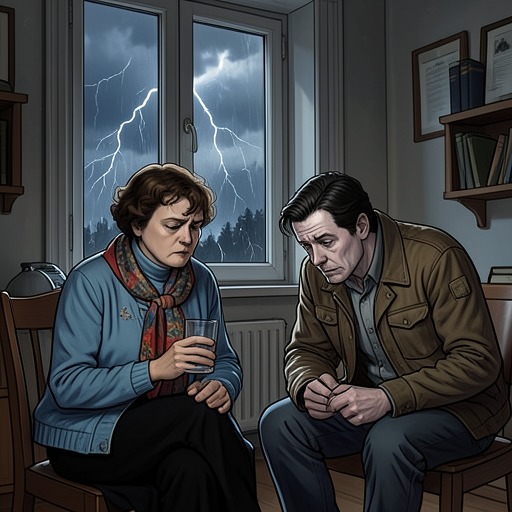
Their silence is therefore not calm or mutual acceptance. Important matters, including death and burial, remain to be discussed, while Helge’s fear is expressed through imagined details of what will happen to his body: the wait in a freezer, the cold stiffening of his cheeks, and cremation at immense heat. He longs for Astrid to find a miracle or wake him from what feels like a bad dream. The plea expresses how dependent he has become on her, but it also exposes the limit of her power: she can tend to him and hear his terror, not undo the illness.
Dependence and the Limits of Reassurance
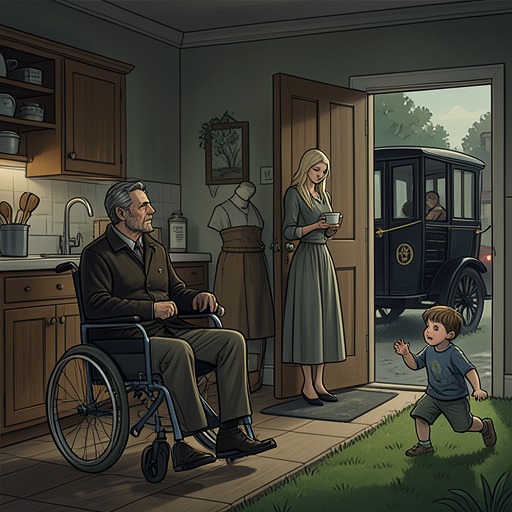
Helge’s dependence is accompanied by shame and alarm at being seen. When Astrid notices that he is trying to manoeuvre his wheelchair toward the window, she understands that he does not want people coming into the house or witnessing him in such a weakened state. His question about whether the visitors will have to come inside is anxious, and his voice has little strength. Astrid answers quickly that they will not. She then promises to go and speak to the man outside, trying to shield Helge from an encounter he cannot control.
Even the couple’s ordinary shared space is altered by the illness. Astrid sometimes sits beside Helge, but she also needs distance from the despair she feels in him and in herself. When he asks for help to lie down, he cries against the bedroom wall while she watches television. The scene does not resolve into an accusation or a reconciliation. It shows two people living the same crisis in different forms: Helge overwhelmed by fear of dying, Astrid overwhelmed by the work of accompanying him and by her own inability to meet every expectation of care.
The Hearse at the Gate
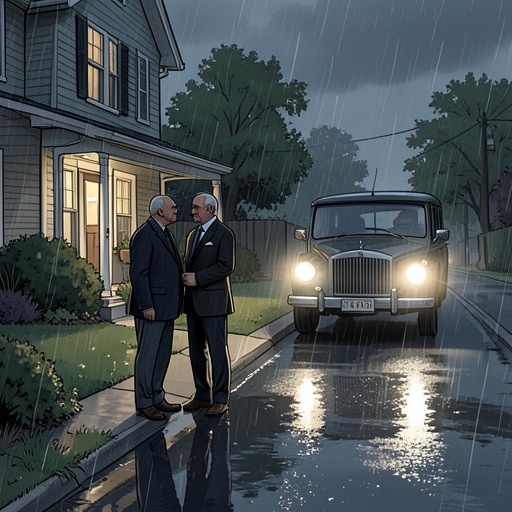
The prank hearse makes their unspoken subject impossible to keep outside the house. As Astrid irons a blue shirt with a white collar and cuffs—one of Helge’s best, though she knows he will never wear it again—she sees a large black car bearing a cross on its roof reverse into the driveway. Its slow approach and brief stop at the gate first leave her unsure what she is seeing; once she recognizes it as a hearse, she panics. Helge has heard the car too, and she tries to prevent him from seeing it.
The car remains in the driveway with its engine running while Astrid speaks to a man in a dark suit. When she returns, Helge is sitting by the window, his face pale in the evening light. Asked what the car is doing there, she tells him someone called it, but that it was only a prank. She places the incident among the recent fabrications and hoaxes, including fake newspaper obituaries and the episode involving a baby in Bjerketun, and suggests that boys may be responsible. Her explanation supplies a mundane category for the intrusion, but it cannot make the image harmless to a man already imagining the details of his own death.
Astrid turns away, imagining that Helge may blame her, although she has done nothing to cause the prank. The moment brings the marriage’s central strain into sharp focus: she wants to protect him, but cannot protect him from his disease, his knowledge of what is coming, or the cruel spectacle staged outside their home. The hearse is not a sign that Helge has died; it is an act of intimidation that makes death visible while he is still alive. For Astrid and Helge, the intrusion gives an external shape to the fear that has already been governing their private life.